
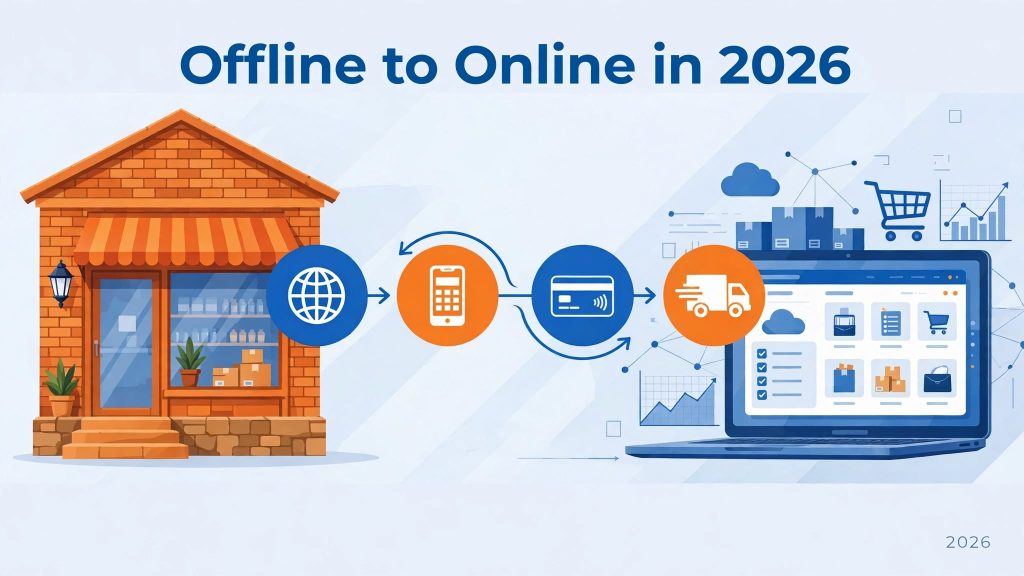
For many years, businesses in India grew through physical shops, offices, personal relationships, referrals and word of mouth. That still matters.
But if you’re wondering how to take your offline business online and get more customers in 2026, the way customers discover businesses has completely changed.
Today, someone hears about your shop from a friend and immediately searches your name on Google. Someone else searches “service near me” or asks an AI assistant “best manufacturer in Surat for…”. If your business is not discoverable, understandable and contactable online, you are invisible at the exact moment they are ready to buy.
This practical guide is for small and growing offline businesses, startups, retailers, manufacturers and service providers in India who want to build a strong online presence without leaving their offline business behind. You don’t need a huge budget. You need to build a strong online layer around your existing business.
This creates an important opportunity for traditional businesses:
You don’t have to leave your offline business behind. You need to build a strong online layer around it.
Taking your business from offline to online does not simply mean creating an Instagram account or putting up a website. It means making your business discoverable, understandable, trustworthy and accessible online.
This guide explains how to do it step by step.
What Does “Taking a Business Online” Actually Mean?
Taking a business online means creating a digital presence that allows people to:
- Discover your business
- Understand what you offer
- See where you are located
- Learn about your products or services
- Contact you easily
- Ask questions
- Read useful information
- See your work and experience
- Build confidence in your business
- Take the next step toward becoming a customer
For some businesses, that may eventually include online ordering, e-commerce, online appointments, payments or a complete digital operation.
For others, the primary purpose may simply be getting discovered and generating enquiries.
There is no single online strategy that works for every business.
The right approach depends on your industry, customers, location, budget and goals.
Step 1: Understand Your Business Before Going Online
Before creating a website or social media accounts, clearly define what your business actually provides.
Ask yourself:
What do we sell?
List your products or services in simple language.
Who are our customers?
Think about the people who are most likely to need what you provide.
What problems do we solve?
Customers generally do not search for your company because they want to learn about your business history.
They search because they have a problem, requirement or goal.
For example:
A customer doesn’t necessarily search for:
“ABC Furniture Company”
They may search for:
“Custom furniture near me”
or
“Office furniture manufacturer in Surat”
Understanding this difference can completely change your online strategy.
What makes our business different?
It could be:
- Experience
- Quality
- Location
- Pricing
- Customization
- Service
- Speed
- Expertise
- Product range
- After-sales support
- Local reputation
Your online presence should communicate these differences clearly.
Step 2: Choose a Professional Business Name and Domain
Your business name should be consistent across your digital presence wherever practical.
The next important step is choosing a domain name for your website.
For example:
yourbusiness.com
A professional domain helps establish a recognizable digital identity.
Try to choose a domain that is:
- Easy to remember
- Easy to spell
- Related to your business name
- Professional
- Consistent with your branding
Avoid making the domain unnecessarily complicated.
Your website address may eventually appear on:
- Business cards
- Google search results
- Social media
- Advertisements
- Email signatures
- Invoices
- Packaging
- Brochures
Your domain therefore becomes part of your business identity.
Step 3: Build a Professional Business Website
A website can become the central foundation of your online presence.
Social media platforms can help people discover you, but your website gives you a place where you control the presentation of your business information.
A business website should clearly answer:
Who are you?
What do you offer?
Who do you serve?
Where are you located?
Why should someone contact you?
A basic business website may include:
- Home
- About Us
- Services
- Products
- Industries Served
- Portfolio / Projects
- Blog / Knowledge Centre
- FAQs
- Contact Us
- Privacy Policy
- Terms & Conditions
The exact structure should depend on the business.
Don’t make the website only about yourself
One common mistake is filling every page with statements such as:
“We are the best.”
“We provide the best quality.”
“We are a leading company.”
Instead, explain how your products or services help customers.
A useful website answers customer questions before the customer has to ask them.
Step 4: Make Your Website Mobile-Friendly
A large portion of online activity happens on smartphones.
Therefore, your website should work properly across:
- Mobile phones
- Tablets
- Laptops
- Desktop computers
Check:
- Text readability
- Button sizes
- Navigation
- Page loading
- Contact forms
- Images
- Menus
- WhatsApp/contact buttons
A beautiful desktop website that is difficult to use on a smartphone can create a poor customer experience.
Step 5: Create Your Google Business Presence
If your business serves a particular geographic area, your presence on Google’s local ecosystem can be extremely important.
Make sure your business information is accurate and consistent.
Depending on your business, this may include:
- Business name
- Address
- Phone number
- Website
- Opening hours
- Business category
- Services
- Photos
- Products
- Customer reviews
Keep information updated.
If your business moves, changes its phone number or changes opening hours, update the relevant online information.
The objective is simple:
When people search for your business or the services you provide, they should be able to understand who you are and how to reach you.
Step 6: Start Building Your Social Media Presence
Social media should not simply become a place where you repeatedly post advertisements.
Use it to demonstrate that your business is active, useful and real.
Depending on your audience and industry, you may consider platforms such as:
- YouTube
- Other relevant platforms
You don’t necessarily need to be everywhere.
It is often better to consistently maintain a few relevant channels than create accounts everywhere and abandon them.
What can you post?
Consider:
- Educational tips
- Product demonstrations
- Before-and-after examples
- Customer questions
- Behind-the-scenes content
- Industry information
- Frequently asked questions
- Case studies
- Short videos
- Company updates
- Helpful guides
- Important announcements
The goal is not simply:
“Look at our company.”
It can also be:
“Here is something useful for you.”
Step 7: Turn Your Business Knowledge Into Content
This is one of the most powerful opportunities for an offline business.
Your team already knows a lot.
Customers ask questions every day.
Those questions can become online content.
For example, a plumbing company may regularly hear:
“Why is my water pressure low?”
A travel company may hear:
“What documents are required for Umrah?”
A restaurant may hear:
“How should we choose a menu for a business event?”
An IT company may hear:
“Do I need a website for my small business?”
Each question can potentially become:
- A blog article
- FAQ
- Video
- Social media post
- Short-form video
- Infographic
- Knowledge-base article
This creates something valuable:
Your offline experience becomes online knowledge.
Step 8: Make Your Business Easy to Find in Search
Creating a website is only the beginning.
People need to be able to discover it.
This is where search engine optimization, commonly called SEO, becomes important.
SEO involves improving your website and content so search engines can better understand your pages and users can discover relevant information.
Start with the basics:
Use clear page titles
Instead of:
Services
Consider something more descriptive where appropriate:
Website Development Services for Small and Growing Businesses
Use useful headings
Organize information logically.
Write for humans first
Do not fill pages with repetitive keywords.
Answer real questions
Create content based on what your customers actually want to know.
Keep business information consistent
Your name, services, contact information and location should be clear and accurate.
SEO is not simply about putting keywords on a page.
It is about creating useful information that search systems and people can understand.
Step 9: Prepare Your Business for AI-Powered Search
Search is evolving.
People increasingly use AI-powered tools and assistants to ask questions in conversational language.
Instead of searching:
“web developer Surat”
someone may ask:
“What should a small business consider before hiring a web development company in Surat?”
This means businesses should increasingly think about answering questions clearly, not just targeting individual keywords.
Create useful content around:
- Common customer questions
- Service explanations
- Comparisons
- How-to guides
- Definitions
- FAQs
- Industry knowledge
- Local information
- Product information
Make your content easy to understand and factually responsible.
Don’t publish information simply to create more pages.
Publish information because it helps someone.
Step 10: Make Contact Extremely Easy
Imagine someone discovers your business online at 10:30 PM.
They want to ask a question.
Can they contact you easily?
Your website may provide:
- Phone number
- Contact form
- Business location
- Appointment request
- Enquiry form
The exact options depend on your business.
But avoid making visitors search through several pages just to find a phone number.
A digital presence should reduce friction between:
“I am interested.”
and
“I want to contact you.”
Step 11: Build Trust Online
Moving online is not simply about visibility.
It is also about trust.
A potential customer who has never met you may look for evidence that your business is genuine.
Useful trust signals can include:
- Real business information
- Clear contact details
- Professional website
- Customer reviews
- Project examples
- Case studies
- Certifications where relevant
- Team information
- Business photographs
- Helpful educational content
- Clear policies
- Consistent branding
If you have completed real projects, demonstrate them.
Instead of saying:
“We have extensive experience.”
Show examples of the work where appropriate.
Evidence is generally more useful than claims.
Step 12: Connect Your Offline and Online Business
Your offline business and online business should not operate as two completely separate worlds.
Connect them.
For example, add your website to:
- Business cards
- Signboards
- Brochures
- Invoices
- Product packaging
- Email signatures
- Vehicle branding
- Quotations
Add QR codes where appropriate.
Similarly, use your website and social media to direct people toward your physical location, phone number, appointment system or other offline services.
The goal is to create one connected customer journey.
Step 13: Start Collecting and Answering Customer Questions
One of the easiest ways to continuously improve your online presence is to listen to customers.
Keep a simple list of questions your customers ask.
Every month, identify questions that could become online resources.
For example:
Question → Content
“What does this service cost?”
→ Pricing guide or factors affecting pricing
“How long does it take?”
→ Service timeline article
“Which product should I choose?”
→ Comparison guide
“Do you provide service in my area?”
→ Service-area page
“What documents do I need?”
→ Checklist
This creates a content system based on real customer needs rather than random topics.
Step 14: Don’t Try to Do Everything at Once
One of the biggest mistakes businesses make when going online is trying to launch everything simultaneously.
Website.
YouTube.
Instagram.
Facebook.
Blog.
SEO.
Advertising.
E-commerce.
Email marketing.
Automation.
AI.
It can quickly become overwhelming.
Instead, build in stages.
Stage 1: Foundation
- Business domain
- Professional website
- Business information
- Contact options
- Google presence
Stage 2: Visibility
- SEO fundamentals
- Social media
- Local visibility
- Useful content
Stage 3: Trust
- Reviews
- Case studies
- Portfolio
- FAQs
- Educational resources
Stage 4: Growth
- Digital advertising
- Lead generation
- Email marketing
- Online sales
- Automation
- Analytics
Stage 5: Optimization
Measure what is happening and improve the areas that need attention.
Step 15: Measure More Than Followers
Followers are only one metric.
A business should also look at meaningful indicators such as:
- Website visitors
- Search visibility
- Enquiries
- Phone calls
- WhatsApp conversations
- Contact-form submissions
- Online purchases
- Appointment requests
- Content engagement
- Returning visitors
- Customer reviews
A business with 500 highly relevant visitors may receive more useful enquiries than a business with thousands of irrelevant visitors.
The objective should therefore be useful visibility, not simply large numbers.
A Simple Offline-to-Online Roadmap
If you are starting from zero, here is a practical roadmap:
Phase | What to Build |
1. Foundation | Domain, branding and business information |
2. Website | Professional mobile-friendly website |
3. Local Presence | Google business information and local visibility |
4. Social | Relevant social media profiles |
5. Content | FAQs, articles, videos and useful resources |
6. SEO | Search-friendly structure and content |
7. Trust | Reviews, portfolio and case studies |
8. Enquiries | Phone, WhatsApp, forms and other contact options |
9. Measurement | Analytics and enquiry tracking |
10. Growth | Advertising, automation, e-commerce and advanced digital solutions |
You don’t have to complete everything in one week.
Build the foundation first. Then grow.
Common Mistakes Businesses Make When Going Online
1. Creating a website and forgetting about it
A website should be maintained and updated.
2. Copying competitors
Your online presence should reflect your own business, experience and customers.
3. Focusing only on advertising
Not every visitor is ready to buy immediately.
Useful information can help build trust before a purchase decision.
4. Publishing low-quality content
More content does not automatically mean better content.
Useful, accurate and relevant information matters.
5. Ignoring mobile users
A website that works poorly on smartphones can lose potential customers.
6. Making exaggerated claims
Statements such as “No. 1”, “best”, or “guaranteed results” should not replace evidence.
7. Ignoring customer questions
Your customers are telling you exactly what information they need.
Listen to them.
8. Expecting overnight results
Digital growth can take time.
A strong online presence is usually built through consistent improvement rather than one large action.
What About a Small Offline Business With a Limited Budget?
You don’t necessarily need a huge budget to begin.
Start with the essentials.
First priority
Create a professional digital identity and website.
Second priority
Make your business easy to find locally and easy to contact.
Third priority
Create useful content answering customer questions.
Fourth priority
Build social proof and demonstrate your work.
Fifth priority
Consider paid advertising once your foundation is ready.
The important principle is:
Don’t spend money simply because something is called “digital marketing.”
Understand what you are trying to achieve first.
From Local Business to Digital Brand
Going online can eventually become much more than simply getting a website.
A local business can gradually build:
Offline reputation → Website → Search visibility → Content → Social presence → Online enquiries → Digital relationships → Digital brand
This transformation doesn’t happen overnight.
It happens through consistent work.
A business that has served customers offline for years already possesses something extremely valuable:
real-world experience.
The next step is to make that experience visible and useful in the digital world.
Final Thoughts
Your Offline Reputation Is Your Biggest Online Advantage
Taking your business from offline to online does not mean abandoning how you have traditionally worked. Your shop, your office, your personal relationships and your existing customers remain.
It means extending your business to where your customers are already searching — on Google, on Maps, on social media, and increasingly in AI-powered search and assistants. When you build your business to be discoverable online, understandable online, contactable online and trusted online, you turn years of offline experience into daily online enquiries.
You don’t have to launch everything at once. Start with the foundation — a professional domain and mobile-friendly website — then build visibility, trust and growth step by step.
How Brelicon Technologies Can Help
Moving from offline to online involves many pieces — from website design and development and mobile applications to SEO and local visibility, custom software, SaaS and AI solutions
At Brelicon Technologies, based in Palsana, Surat, we work with offline businesses across Gujarat and India to create a practical roadmap based on your industry, customers, location and budget — not a one-size-fits-all package.
If you are starting your digital journey, let’s start with a free consultation to understand what your customers are searching for and what your online presence should accomplish first
.Your business already has a story offline. Now it’s time to make that story discoverable online
.Contact: +91 97129 29932 | WhatsApp: +91 97129 29932 | Email: info@brelicontechnologies.com
FAQ (Frequently Ask Question)
Q1. How can I take my offline business online in India with a small budget?
A1. Start with the essentials. First, get a professional domain and mobile-friendly website. Second, set up your Google Business Profile and make contact easy via phone and WhatsApp. Third, create useful content answering customer questions. Build reviews and portfolio next, and only then invest in paid advertising.
Q2. What are the common mistakes businesses make when going online?
A2. Creating a website and forgetting to update it, copying competitors, focusing only on ads, publishing low-quality content, ignoring mobile users, making exaggerated claims like No. 1 without proof, ignoring customer questions, and expecting overnight results.
Q3. Do I need to be on every social media platform?
A3. No. It is better to consistently maintain 2-3 relevant channels where your customers are active than to create accounts everywhere and abandon them.
Q4. How long does it take to get customers after taking business online?
A4. While a website and Google Business Profile can start generating visibility in a few weeks, strong search visibility and regular enquiries are usually built over 3-6 months through useful content and reviews.
Q5. What should a basic business website include?
A5. Home, About Us, Services or Products, Portfolio, FAQs, and Contact with phone, WhatsApp and enquiry form. It must be mobile-friendly and clearly answer who you are, what you offer, and why someone should contact you.