
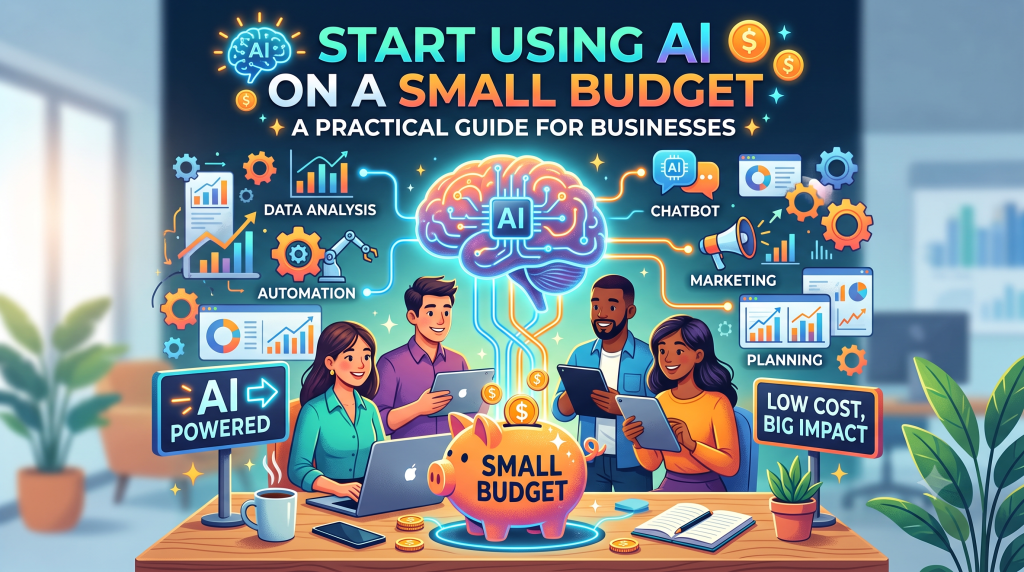
Artificial Intelligence is no longer only for large corporations with huge technology budgets.
Today, even a small business, startup, local shop, professional service provider, agency, manufacturer, or growing company can start using AI to save time, improve productivity, communicate better with customers, and make smarter business decisions.
The biggest misconception is that businesses need to spend a large amount of money before they can benefit from AI.
They don’t.
In many cases, the best way to start is with a small problem, a simple AI tool, and a clear objective.
The goal should not be:
“How can we use AI everywhere?”
The better question is:
“Where can AI save our business time, reduce repetitive work, or help us serve customers better?”
That small change in thinking can make AI much more practical and affordable.
Why Small Businesses Should Start Thinking About AI
Small businesses often operate with limited resources.
One person may handle customer communication. Another may manage sales, marketing, administration, accounts, or operations.
A significant amount of time can disappear into repetitive tasks such as:
- Writing emails
- Preparing social media content
- Creating marketing ideas
- Answering frequently asked questions
- Summarizing documents
- Preparing reports
- Organizing information
- Writing product descriptions
- Researching competitors
- Creating meeting notes
- Drafting proposals
- Responding to routine customer enquiries
AI can help with many of these activities.
The objective isn’t necessarily to replace employees.
The objective is to help people spend less time on repetitive work and more time on valuable work.
1. Start With a Problem, Not With an AI Tool
One of the biggest mistakes businesses make is choosing an AI tool first and then trying to find something to do with it.
Reverse the process.
Start by asking:
“What takes too much time in our business?”
For example:
A company may spend several hours every week writing social media content.
Instead of immediately purchasing an expensive AI platform, the company could first experiment with an AI writing assistant to generate content ideas, captions, outlines, and first drafts.
Another business may receive the same customer questions every day.
Instead of manually answering every question, it could create an FAQ knowledge base and explore AI-assisted customer support.
Another company may spend hours summarizing documents and preparing internal reports.
AI may be able to reduce that workload.
Find the repetitive problem first. Then find the appropriate AI solution.
2. Begin With Low-Cost or Free AI Tools
Businesses don’t always need expensive enterprise AI software to get started.
Many AI platforms offer free or relatively affordable plans that can be useful for experimentation.
Depending on the task, businesses can explore AI for:
- Writing and editing
- Brainstorming
- Research
- Summarization
- Translation
- Image creation
- Content planning
- Data analysis
- Customer support
- Coding assistance
- Documentation
- Meeting summaries
The important thing is not how many tools a company uses.
The important thing is whether the tool solves a real business problem.
A company using two useful AI tools effectively can gain more value than a company subscribing to twenty different platforms
Real Example from Surat: A textile shop in Palsana was spending 12 hours/week writing product descriptions. Using a simple AI writing assistant (₹1500/month plan), they now do it in 3 hours. No custom software..
3. Use AI to Save Employee Time
Time is one of the most valuable resources in any business.
If AI can reduce a repetitive task from two hours to thirty minutes, that time can potentially be redirected toward customers, sales, strategy, product development, or other important activities.
Consider a simple example.
A business employee spends 30 minutes preparing a standard customer email.
If the business receives 20 similar requests each week, that could represent approximately:
10 hours every week.
AI could potentially help create a first draft or standardized response that the employee reviews and personalizes.
The employee remains responsible for the final communication.
AI simply helps accelerate the process.
4. Improve Your Content Marketing With AI
Marketing is another area where smaller businesses can benefit from AI.
A business doesn’t necessarily need a large marketing department to start producing useful content.
AI can assist with:
- Blog topic ideas
- Article outlines
- Social media concepts
- Video scripts
- Captions
- Email drafts
- FAQ creation
- Content calendars
- Headline variations
- Customer persona brainstorming
- SEO content planning
However, businesses should avoid simply publishing everything AI generates.
AI should help create content. Human knowledge should make the content valuable.
Your experience, industry knowledge, examples, opinions, customer questions, and real-world insights are what can make the final content genuinely useful.
5. Turn Frequently Asked Questions Into a Knowledge Base
One of the most affordable AI opportunities for many businesses is something surprisingly simple:
Organizing existing knowledge.
Think about the questions customers ask repeatedly.
For example:
- What services do you provide?
- How long does a project take?
- What information do you need from customers?
- What is your pricing process?
- How does your product work?
- What are your delivery options?
- How can customers contact support?
Instead of answering the same questions repeatedly, businesses can create a structured knowledge base.
A well-organized knowledge base can also become useful for website search, customer support, chatbots, and AI-powered search experiences.
This creates value from information the business already possesses.
6. Don’t Automate Everything Immediately
Automation sounds attractive.
But businesses should be careful.
A common mistake is trying to automate an entire business process before understanding it properly.
A better approach is:
Manual → Assisted by AI → Partially Automated → Fully Automated where appropriate
For example:
Stage 1 — Manual
An employee writes every customer response.
Stage 2 — AI Assisted
AI creates a draft and the employee reviews it.
Stage 3 — Partially Automated
Common questions receive AI-assisted responses while unusual questions go to employees.
Stage 4 — Optimized
The company measures the system and improves it based on real customer interactions.
This gradual approach reduces risk and unnecessary spending.
7. Train Your Team to Use AI Properly
Buying an AI tool does not automatically create an AI-powered business.
People need to know how to use it.
Employees can begin with simple skills such as:
- Writing better prompts
- Checking AI-generated information
- Protecting confidential information
- Editing AI-generated content
- Comparing AI outputs
- Understanding when human judgment is required
- Creating reusable prompts and workflows
Even a small internal AI guide can make a difference.
For example:
“Before using AI, never enter confidential customer information, passwords, financial credentials, or sensitive business data into an AI service unless the organization has approved the tool and its data handling.”
Responsible use should be part of the AI strategy from the beginning.
8. Measure the Result Before Spending More
AI adoption should not be based only on excitement.
Measure the outcome.
Before introducing an AI workflow, ask:
How much time does this task currently take?
Then measure it after introducing AI.
For example:
| Task | Before AI | With AI Assistance |
|---|---|---|
| Drafting an email | 20 minutes | 8 minutes |
| Creating content ideas | 60 minutes | 20 minutes |
| Summarizing a document | 30 minutes | 10 minutes |
| Preparing an FAQ draft | 3 hours | 1 hour |
These numbers are only examples, but the principle is important.
Measure time saved, quality, customer response, and business impact.
If the result is valuable, expand the use case.
If it isn’t, change the approach.
9. Build an AI Budget Slowly
Businesses don’t need to make a large AI investment on day one.
A practical approach is to create an AI experimentation budget.
For example:
Step 1
Identify one business problem.
Step 2
Test an affordable AI solution.
Step 3
Run the experiment for a defined period.
Step 4
Measure the result.
Step 5
Keep it if it creates value.
Step 6
Expand only when there is a clear reason.
This approach turns AI investment into a learning process rather than a large financial commitment.
10. Think About AI as a Business Capability
AI should not be treated simply as another software subscription.
The bigger opportunity is learning how AI can become part of the way a business works.
A company may eventually use AI across several areas:
Marketing → Sales → Customer Support → Operations → Documentation → Analysis → Product Development
But there is no need to implement everything at once.
Start small.
Learn.
Measure.
Improve.
Then expand.
A Simple AI Starting Plan for Small Businesses
Here is a practical 30-day approach.
Week 1 — Identify
Find three repetitive tasks in your business.
Ask employees:
“What task do you do repeatedly that consumes more time than it should?”
Week 2 — Experiment
Choose one task and test an affordable AI solution.
Don’t attempt to transform the entire business.
Week 3 — Improve
Create a repeatable workflow.
Document the prompts, instructions, review process, and expected output.
Week 4 — Measure
Compare the results.
Did you save time?
Did quality improve?
Did customers receive faster responses?
Did employees find the process useful?
If the answer is yes, consider expanding.
The Real Cost of Not Learning AI
Businesses often ask:
“How much will AI cost us?”
There is another question worth asking:
“How much time are we losing by not learning how to use AI?”
AI adoption does not necessarily mean spending thousands of dollars.
Sometimes it means spending a few hours learning how to use an existing tool more effectively.
The competitive advantage may not come from having the most expensive AI system.
It may come from having a team that knows how to use simple AI tools intelligently.
AI Does Not Replace Business Thinking
This is perhaps the most important point.
AI can generate text.
AI can analyze information.
AI can summarize documents.
AI can help create ideas.
AI can assist with repetitive work.
But businesses still need:
Experience.
Strategy.
Creativity.
Human judgment.
Customer understanding.
Trust.
The businesses that benefit most from AI are unlikely to be those that simply generate the most AI content.
They will be the businesses that combine human thinking with intelligent technology.
Where Brelicon Technologies Can Help
For businesses that are unsure where to begin, the first step should not necessarily be buying another AI subscription.
It should be understanding where technology can create the greatest practical value.
Brelicon Technologies works with businesses on digital solutions including web development, web-based applications, software development, mobile applications, SEO, IT consulting, and AI-oriented solutions.
The right technology strategy depends on the business, its customers, existing systems, budget, and goals.
Sometimes the best solution is a sophisticated AI system.
Sometimes it is simply a better website, a structured knowledge base, an improved workflow, or an AI-assisted process.
Technology should serve the business—not the other way around.
Final Thought
You don’t need a huge budget to start using AI.
You need a useful problem, a practical solution, responsible implementation, and the willingness to learn.
Don’t try to make your entire business “AI-powered” overnight.
Start with one task.
Save some time.
Learn what works.
Measure the result.
Then take the next step.
Because the future may not belong to businesses that simply use the most AI.
It may belong to businesses that know where AI actually creates value.
Start small. Think smart. Build gradually.
AI is not only for big businesses anymore.
Brelicon Quick Win Audit: Not sure where to start? We map your 3 most repetitive tasks for FREE and tell you which one to automate first. DM “AI AUDIT”